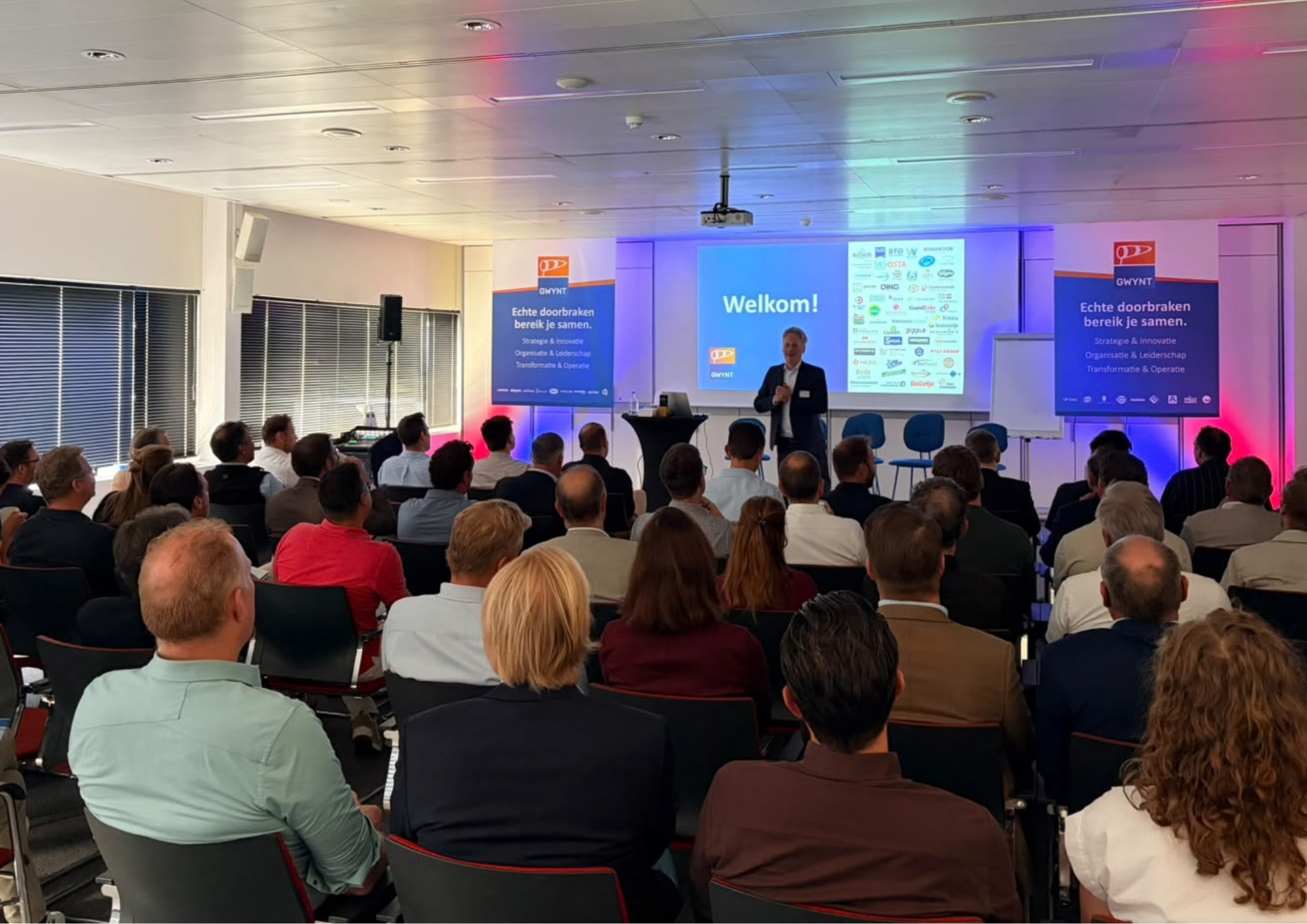
On Wednesday, September 30, during Gamechangerz in Food & Agri, executives, entrepreneurs, and experts from the food and agriculture sector gathered at the Evoluon in Eindhoven. The event centered on one question: How do you translate the rapidly growing possibilities of artificial intelligence into tangible value for your organization?
Virtually every organization recognizes the potential of AI. At the same time, many companies find it difficult to determine where to start, which applications actually add value, and how successful experiments can be scaled up. The central question of the day was therefore not so much what AI can do, but how organizations can strategically deploy AI to enhance their performance, innovation capacity, and competitiveness. This now encompasses not only generative AI and applications such as Microsoft Copilot or Claude, but also machine learning, data analytics, and AI agents that support decision-making and processes.
AI is changing more than just technology
During the various keynote speeches and breakout sessions, it became clear that AI goes far beyond being just a new tool or technology. AI impacts business models, value chains, and the way organizations are structured. As a result, AI affects not only processes, but also decision-making, collaboration, and leadership.
Whether the topic was innovation, supply chain planning, production, HR, or team development, the same message kept coming up. Organizations that successfully implement AI don’t start with technology, but with the question of where AI can actually create value for customers, employees, and the organization as a whole. From demand forecasting and product development to workforce planning and knowledge management: AI and data analytics only become meaningful when they contribute to a specific business objective.
From Experimentation to Impact
Many organizations are still in an experimental phase. They are conducting pilot projects, testing various applications, and exploring new possibilities. This yields valuable insights, but does not automatically lead to sustainable results.
The real-world examples presented at Gamechangerz demonstrated that the greatest benefits arise when AI is linked to specific business challenges. These include better decision-making, faster innovation, higher productivity, more objective quality control, and smarter utilization of talent and knowledge within the organization. Examples from companies such as GoodLife Foods, Bolletje, and Bouter Cheese highlighted how AI is becoming increasingly central to food manufacturing, the supply chain, and operations.
Successful organizations stand out not by conducting more experiments, but by learning faster, making informed choices, and scaling up successful applications.
People Make the Difference
A second key theme was the role of people. Virtually every session emphasized that technology is rarely the limiting factor. Leadership, skills, collaboration, and the ability to adapt ultimately determine whether AI actually delivers value. Examples related to talent matching and team development—including those from 8vance andCIRCYOULAR—underscored that skills and collaboration become more important as AI takes on more tasks.
AI is taking over more and more routine tasks, but this actually makes human skills even more important. Judgment, creativity, collaboration, and leadership are becoming key to the success of organizations in a world where AI is increasingly supporting their work. In supply chain planning as well—an area where Slimstock, among others, develops applications—the role of employees is shifting from processing data to assessing exceptions, scenarios, and decisions.
What does this mean for your organization?
Many organizations face the same questions:
- Where do we see the greatest opportunities?
- Which applications actually deliver results?
- How do we foster a sense of ownership?
- How do we get employees on board?
- How can we ensure that AI doesn’t remain limited to isolated experiments?
According to Gwynt, that is precisely where the greatest challenge—and the greatest opportunity—lies. Not in selecting the right technology, but in connecting strategy, people, processes, and data to truly translate AI into lasting value.
Our conclusion
The question is no longer whether AI will have an impact on the food and agriculture sector. That impact is already evident. Contributions from AI partners and technology companies such as Pipple, Hypersolid, QING, Slimstock, 8vance, andCIRCYOULAR, along with practical experiences from food companies such as Beko, GoodLife Foods, Bolletje, and Bouter Cheese, illustrate the breadth of this development. The organizations that will make a difference in the coming years are those that know how to translate AI into better decision-making, stronger teams, smarter processes, and new forms of value creation.
Curious about what AI can do for your organization? Gwynt is happy to help you explore the strategic, organizational, and operational decisions needed to successfully implement and scale AI.